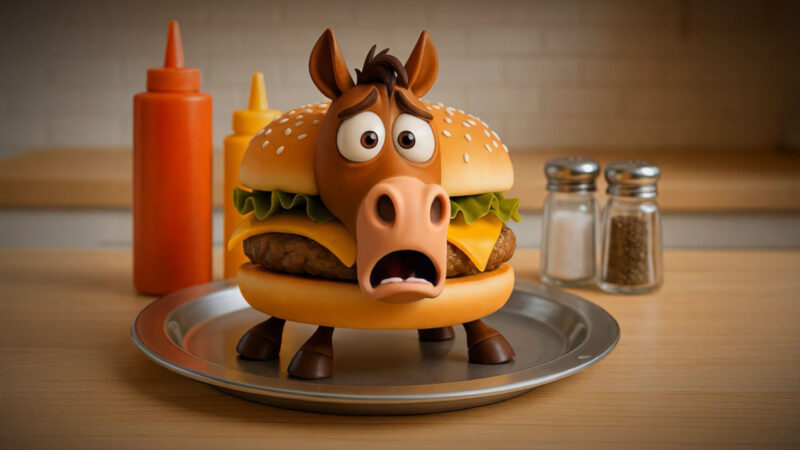
Introducing… Strange Things to Eat
This animation is an original UP concept, written by us, with music by Zeth Townsend. The rest is AI. By combining curated AI generation with hands-on direction, we’ve created in weeks what might’ve taken months. Take a look.
Obviously AI is a hot potato at the moment, so we’ve put together some FAQs outlining our position.
Give it a read and let us know what you think.
Q1: Isn’t Generative AI harmful to the environment because of high energy use?
A: It’s true that training large AI models uses a lot of energy. But once those models are trained, generating new content is much less resource-intensive.
Let’s put it in perspective:
- Traditional animation might take a skilled artist 5-7 days to create one minute of content; modelling assets, rendering frames, and tweaking the final output. This relies on powerful machines and cloud rendering, all using electricity over many hours.
- Generative AI, on the other hand, can produce similar visuals in 2-3 days, with far less ongoing energy use.
So for a small, targeted project like this, the overall carbon footprint may actually be lower than going the traditional route.
Q2: Isn’t AI-generated imagery “fake” and potentially misleading?
A: It depends on how it’s used. In this case:
- The animation is clearly stylised, it’s not trying to pass as real footage.
- Its purpose is to tell a story and convey a message, not to deceive.
- Like stop-motion, illustration, or puppetry, this is just another artistic medium. Whether the images are drawn by hand or generated by a model doesn’t change the intent.
As long as the audience understands the context, the focus should be on the message and emotion, not whether it was created by a person or a machine.
Q3: Isn’t it unethical to use AI that’s trained on other people’s work?
A: That’s a fair concern, and the conversation around AI and copyright is ongoing. But here’s how we approach it:
- This project is non-commercial and educational, its goal is to raise awareness, not sell anything.
- The final piece combines AI-generated imagery with original voiceover, story, sound design, and editing.
- We’re not copying anyone’s work, we’re creating something brand new, with a clear and ethical purpose.
It’s about using the tools available to do the most good, in the most responsible way we can.
Q4: Isn’t using AI just taking a shortcut around the creative process?
A: Not really. While AI can help generate images faster, it doesn’t remove the need for creativity. You still need:
- A strong concept
- Visual direction
- Scene composition, pacing, transitions, and sound design
- And someone to decide what works and what doesn’t
AI helps speed things up, but it can’t replace thoughtful storytelling or creative judgement. It’s a tool, not an autopilot.
Q5: Shouldn’t we be hiring human artists instead?
A: Ideally, yes, and we often do. But the reality for many small charities is that budgets are tight.
Often, the choice isn’t between AI and a human artist, it’s between making something… or making nothing at all.
Generative AI helps us:
- Produce content faster and more affordably
- Experiment and iterate with limited resources
In that way, it levels the playing field. It helps small teams like ours compete visually with bigger campaigns, without compromising the message.
Final Thought:
Generative AI isn’t a shortcut, it’s a tool. When used with care, purpose, and creativity, it allows small teams to tell big stories.
For us, it’s about speaking up for animals, clearly, powerfully, and accessibly. And tools like this help us do exactly that.